

BitNest has presented itself as a decentralized crypto ecosystem offering investment products based on smart contracts, USDT and DeFi mechanisms. The project has attracted users with unusually high advertised returns and a wallet-based investment model that does not look like a traditional brokerage platform.
However, a closer examination reveals multiple issues that potential investors should consider before trusting the platform with their cryptocurrency. The combination of high fixed returns, a 17-level referral structure, an internal token and reports of withdrawal problems creates a risk profile that is difficult to ignore.
What Is BitNest?
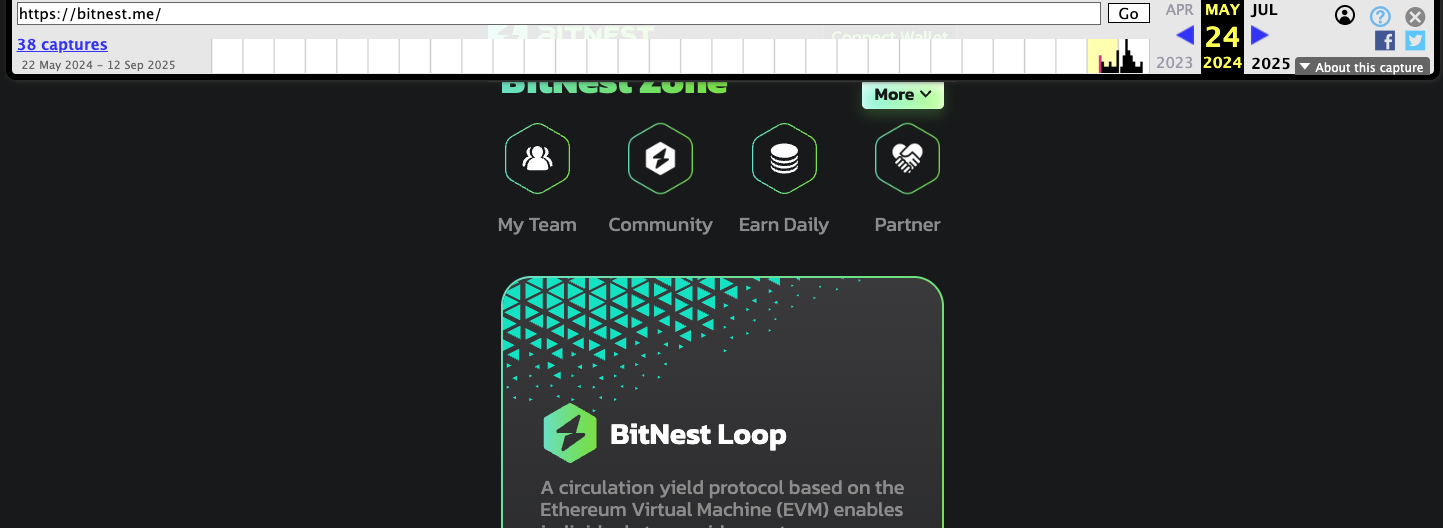
BitNest was promoted as a decentralized financial ecosystem where users could connect a crypto wallet and participate in different products without relying on a conventional broker. Among its main products was BitNest Loop, which offered short-term investment cycles with predetermined returns.
The process was deliberately simple. Users connected a wallet such as MetaMask, selected an available product, deposited USDT and interacted with the corresponding smart contract. This structure may sound safer because transactions take place on the blockchain, but blockchain execution does not guarantee that an investment model itself is financially sustainable.
The Returns Are the First Major Warning Sign
BitNest Loop advertised several investment periods with predetermined returns. The published figures included 0.4% for one day, 4% for seven days, 9.5% for 14 days and 24% for a 28-day cycle.
The 24% figure deserves particular attention. A fixed return of 24% in less than one month is exceptionally high and requires a convincing explanation of where the money for these payments comes from.
Calling the system decentralized or referring to smart contracts does not answer that question. A smart contract can automate a payment, but it cannot create sustainable profits without an underlying economic activity generating those funds.
A 17-Level Referral Structure
Another significant feature of BitNest was its multi-level referral system. Project documentation described rewards extending through as many as 17 levels, with different commission rates depending on the position within the referral structure.
The published rates included 20% on the first level, 10% on the second, 5% on levels three through seven, 3% on levels eight through ten and 1% on levels eleven through seventeen. This structure was also examined by the independent MLM investigation website BehindMLM.
A standard affiliate program pays a commission for directly referring a customer. A 17-level structure is fundamentally more extensive. It creates an incentive for participants to build large networks of new users, which becomes particularly important when combined with an investment product promising high returns.
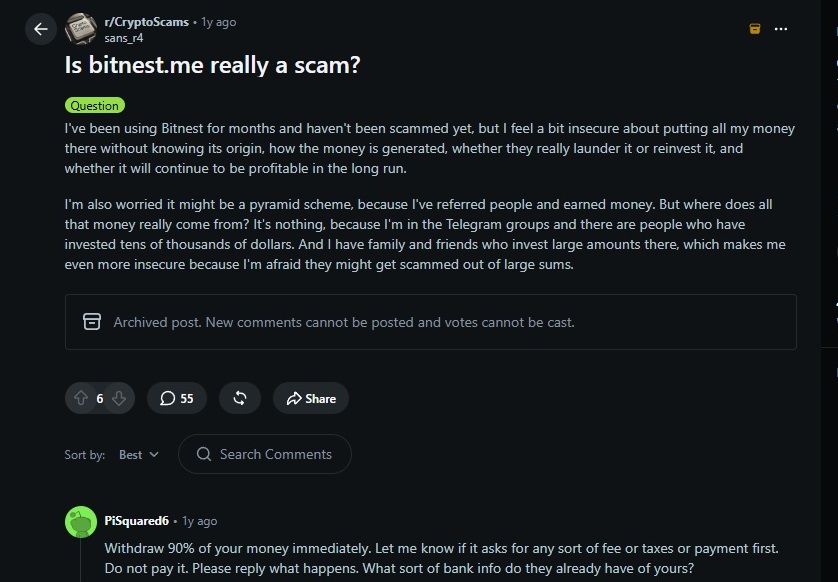
BehindMLM described BitNest as an MLM crypto Ponzi. This is the publication’s assessment rather than a judicial finding, but the underlying existence of the multi-level reward structure is documented in BitNest’s own materials.
DeFi Does Not Mean Risk-Free
BitNest relied heavily on the language of decentralized finance. Users connected their own wallets, interacted with smart contracts and were told that the system operated through blockchain-based mechanisms.
There is nothing inherently wrong with this technical model. The problem is that decentralization does not eliminate financial risk.
An investor still needs to understand how the promised yield is generated, where the deposited assets are used, who controls the contracts and what happens when the underlying strategies fail. Without that information, the technology may provide transparency about transactions while leaving the business model itself difficult to evaluate.
MellionCoin Adds Another Risk Layer
BitNest also developed its own internal token, MellionCoin, or MEC. This created another layer of exposure because users could become dependent on an asset whose value and liquidity were connected to the BitNest ecosystem itself.
This is different from simply holding USDT. An internal token can have a quoted market price while still being difficult to exchange for the cryptocurrency originally deposited by an investor.
The risk becomes even more relevant when an internal token is incorporated into mechanisms designed to address previous user claims. At that point, the investor’s original position can become dependent not only on the platform’s ability to pay, but also on the future liquidity and value of its own token.
Transparency Questions
Another concern is the limited transparency surrounding the project. Independent analysis has raised questions about the people behind BitNest and identified multiple domains associated with the ecosystem.
For a website offering ordinary software services, this might be a relatively minor issue. For a project asking users to commit cryptocurrency to investment products, it is much more important.
Potential investors should be able to establish who operates the platform, which legal entity is responsible for it, where that entity is registered and what legal framework governs the relationship with users. The use of decentralized technology does not remove the need for basic corporate transparency.
Withdrawal Problems
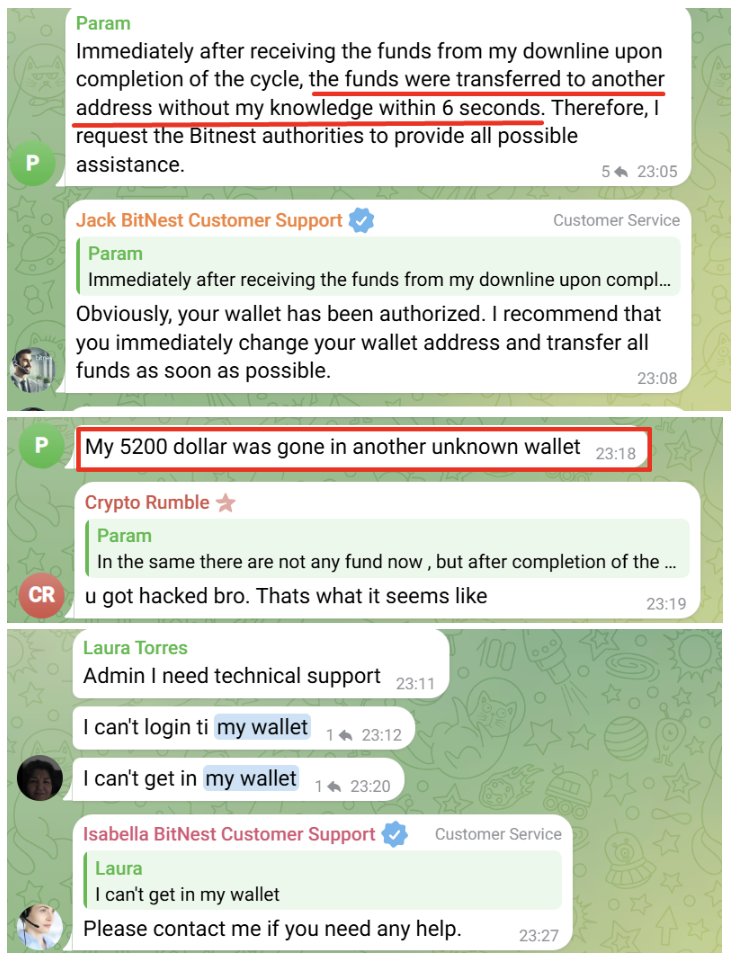
The most serious practical concern is what happens when users attempt to access their funds.
BitNest has received negative user reports concerning delayed operations, withdrawals and investment cycles. These reviews are individual accounts and should not automatically be treated as proof of systematic fraud, but they are relevant because they concern the core function of an investment platform – the ability to receive money back.
Trustpilot currently contains a substantial proportion of one-star reviews for BitNest, while the platform itself notes that reviews represent individual user experiences and may not be representative of the company as a whole.
Several users have described situations in which previous investment cycles were completed successfully, while later transactions remained pending or were not resolved within the expected timeframe. This distinction is important because the existence of earlier successful withdrawals does not prove that the platform can continue meeting all of its obligations indefinitely.
The 2026 Restructuring
The BitNest story became even more complicated in 2026, when the project moved toward a restructuring associated with Mera X.
The new ecosystem introduced the concept of historical user rights and claims. Mera X materials published in September 2026 continued to describe the collection, verification and settlement of these historical rights as an ongoing process.
This is an important development because it changes the nature of the original investment relationship. Instead of simply completing an investment cycle and withdrawing the corresponding funds, some users now have to deal with a separate mechanism for processing historical positions.
Recovery Is Not the Same as a Normal Withdrawal
The recovery arrangements make the situation particularly significant.
Published Recovery Rights materials described mechanisms under which users could receive part of a claimed amount upfront while the remainder would be distributed over a much longer period. One described structure involved 5% upfront and the remaining 95% over 35 months. Another option involved conversion into MEC.
This is a completely different proposition from the original short-term investment model.
A user who deposited USDT into a 28-day product would normally expect the cycle to end with access to the principal and advertised return. A recovery program extending over several years represents a substantial change in the user’s position.
The fact that an internal token can also form part of the proposed recovery mechanism adds another layer of uncertainty for anyone attempting to recover the value of their original assets.
Is BitNest a Scam?
There is an important distinction between identifying serious red flags and making a legal finding of fraud. Calling BitNest legally proven fraud would require an appropriate official finding or court decision.
That does not mean the available evidence should be ignored.
The project combined unusually high advertised returns with a 17-level referral structure, an internal token and limited transparency. It subsequently faced significant questions concerning withdrawals and moved into a restructuring process in which historical user rights became a separate issue.
Taken together, these characteristics create a very high-risk profile. They provide considerably more reason for caution than the project’s DeFi and Web3 branding might suggest.
Final BitNest Review
BitNest should not be evaluated simply by looking at its website, wallet integration or smart contracts. Those features describe how the platform operates technically, but they do not establish whether its investment model is sustainable or whether users can reliably recover their funds.
The most important warning signs are the unusually high promised returns, the extensive referral structure, the internal MEC token, limited transparency and the reports concerning withdrawals. The subsequent transition toward Mera X and the creation of mechanisms for historical user rights make the situation even more complicated.
For anyone considering BitNest or a related project, the relevant questions are straightforward: Who legally operates the platform? Where does the promised yield come from? How are user assets protected? What happens if liquidity becomes insufficient? And, most importantly, can the investor withdraw the original asset without being forced into a long-term recovery arrangement or an internal token?
Until those questions have clear and independently verifiable answers, BitNest should be treated as an extremely high-risk crypto project rather than as a conventional investment platform.
 All BitNest Reviews